


A Checking Account Built Around You
Enjoy everyday banking designed around your lifestyle—with no hidden fees, no stress, and personalized support.

$25 Minimum Deposit to Open An Account

No Minimum Balance Required

Low $5 Monthly Maintenance Fee

No Per-Item Fees
Low-Cost, Low-Fee
Certified Account by Bank On
BankUnited Essentials Checking Account meets the National Account Standards and is proudly certified by Bank On as a low-cost, low-fee account designed to make banking accessible for everyone.
OPEN AN ACCOUNT


Trusted Financial Institution
A Safe Place to Grow Your Money
At BankUnited, security is our top priority. 5-star rating from Bauer Financial
FDIC Insured
5-star rating from Bauer Financial
FDIC Insured
Digital Banking at Your Fingertips
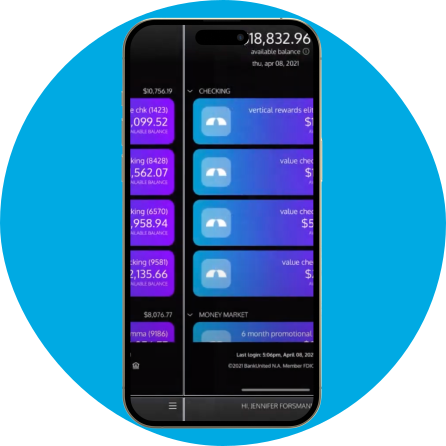
Enjoy the convenience of banking on your terms—whenever you want, anytime you want with our innovative and best-in-class mobile banking app.

Mobile Deposit

Automate Your Bills

Transfer Funds

Account Alerts

Budgeting and Planning

Send Money to Friends & Family
Take Control of Your Finances on Your Terms
Whether you need to check a balance, pay a bill, stop a payment, or pay a friend, the BankUnited mobile banking app is just a tap away.
We're Here to Help You
Have a question about our products or services? We’ve got multiple ways you can get in touch with a Client Care Center representative.


Featured Insights
Get insights on starting and growing your business, managing cash flow, protecting your assets, stories from real clients, and much more.
Are You Keeping Too Much Money in Your Savings Account?
Sep 18, 2024, 10:38 AM
Title :
Are You Keeping Too Much Money in Your Savings Account?
Bank united author :
BankUnited
Featured :
No
Display order :
5
Check out what to consider if your savings account is overfunded.
Saving forms the foundation for good financial health, helping ensure that emergency expenses — like that unexpected medical bill, trip to the vet, or car repair — don’t derail your financial plans. Keeping your money in a savings account is a great way to ensure your cash is readily available when you need it.
However, like many things in life, it’s possible to have too much of a good thing. And storing too much money in your savings account may hold you back from your goals in the long run. But don’t worry: It’s simpler than you think to strike the right balance.
Here’s what you should consider when you’re deciding where to store your savings — and steps to take to set yourself up for financial success.
What are the downsides of storing too much money in your savings account?
Of course, the purpose of a savings account is to help you save money: It’s right there in the name. And while it’s a great place to park your cash, it’s not the most efficient way to make money off your savings.
That’s because the key benefit of savings accounts is convenience and security. Your cash in the account is easily accessible whenever you need it — as in, it’s there to cover that emergency trip to the vet. And, unlike investing your money in the stock market, where your savings may gain or lose value as the market fluctuates, the money in your savings account will retain its value and earn interest according to the rate on your account.
The catch? Savings accounts generally pay less interest, or generate fewer returns, than other savings options.
For example, consider Certificates of Deposit (CDs). Opening a CD requires committing your funds for a defined term, typically ranging from several months to several years.
During that time, you’ll usually earn significantly more interest than you would by keeping the money in a savings account. But, as a trade off, you may not be able to access the money until that time period has expired. And, if you’re able to take out your money early, you may need to pay a penalty to do so.
Similarly, investing your money in the stock market, or in other investments, like bonds, may allow you to generate more returns than you would with your savings account. Over the long term, the stock market has historically outperformed even the highest-interest savings accounts.
The downside is risk: When markets are poor, the value of your investments generally goes down. That means your savings may not be there for you at the specific time you need them.
The solution: Use a savings account for your emergency fund and for short-term goals
Since savings accounts excel at accessibility and stability, they’re an ideal choice to hold your emergency fund as well as to store money for big-ticket expenses, like that vacation you plan to take next year. By keeping just enough cash to cover emergencies or near-term splurges, you can reap the benefits of a savings account without missing out on potential returns.
As for how much to keep in your account, that depends on your lifestyle and goals. The ideal balance should include the cost of big-ticket expenses you’re saving for, plus the balance in your emergency fund.
Generally, experts recommend aiming to keep three to six months’ worth of expenses in your emergency fund. If your monthly expenses are $5,000, for example, aim to save between $15,000 and $30,000 in your emergency fund. If you’re also saving for a $5,000 vacation, you might store up to $35,000 in your savings account in total.
Consider prioritizing returns for long-term goals, including retirement savings
When you’re thinking longer-term, consider putting your savings into an account designed to help you earn money.
If you’re saving for a goal that’s one to three years in the future, a CD may be a good option. With a CD, you’ll be able to earn interest at a predetermined rate, allowing you to generate returns with minimal risk. You’ll be able to retain the value of your savings when you need it, even if the stock market fluctuates in the meantime.
For retirement savings, consider opening an investment account and following an investment strategy that fits your risk tolerance and comfort level. There are virtually unlimited ways to invest, and a financial advisor can help you find a strategy to maximize returns while managing risk.
We’re here to help you find a savings strategy that works for you
Whether you’re opening your first savings account or you’ve already built up a significant nest egg, we’re here to help you find the best way to work toward your goals.
BankUnited offers a variety of savings options, from high-yield savings accounts to certificates of deposit to money market accounts. With the right financial strategy, you can enjoy higher interest rates and better returns on your money.
Ready to get started? Get in touch to take the first step to optimizing your savings plan.
topic :
- Small Business
media :
- Article
