
Skip To Main Content

FDIC-Insured - Backed by the full faith and credit of the U.S. Government

Business Owners discussing financials

Checking Accounts Built For Business Growth

Choose a small business checking account designed to support your day to day operations and long term goals. Whether you need a simple business checking account or more advanced capabilities, BankUnited offers flexible solutions for your business.
Compare All Accounts

Compare Small Business Checking Accounts

PRIMARY BUSINESS CHECKING

$100

minimum opening deposit

  • $12 monthly maintenance fee - Avoid maintenance fee by maintaining average monthly balance of $1500 or more
  • Up to 150 free transactions (deposits, deposited items, checks & debits) per statement cycle
  • Business VISA® Debit Card
  • Bank on the go with online & mobile banking


BUSINESS EXPRESS CHECKING

$100

minimum opening deposit

  • $20 monthly maintenance fee - Avoid monthly maintenance fee by maintaining average monthly balance of $5000 or more
  • Up to 300 free transactions (deposits, deposited items, checks & debits) per statement cycle
  • Business VISA® Debit Card
  • Bank on the go with online & mobile banking


COMMERCIAL ANALYSIS CHECKING

$100

minimum opening deposit

  • $20 monthly maintenance fee
  • Earnings credit available to help offset monthly maintenance fees and other service charges
  • Detailed analysis statements to help keep track of your business banking (upon request)
  • Business VISA® Debit Card
  • Online treasury management services to manage your company's payments, collections, reporting and account balancing

Business Checking Account Benefits

Regardless of your choice, each of our small business bank accounts is built to deliver value, convenience, and control for your business finances.

white bill pay icon

Online Bill Pay

white debit card

Debit Card

estatement white icon

eStatements

white online banking icon

Online and Mobile Banking

Small Business Checking Accounts FAQs


Get answers to common questions about choosing and managing the best business checking account for your company.

The best business checking account depends on your transaction volume, balance, and banking needs. BankUnited offers multiple small business checking accounts to match different business sizes and activity levels.  

You can open a business checking account by contacting BankUnited or visiting a branch. You will typically need business formation documents, identification, and an opening deposit.  

Fees may include monthly maintenance charges, transaction fees, and cash processing fees. Many fees can be avoided by maintaining required balances.  

Yes, BankUnited provides online and mobile banking tools so you can manage your small business bank account anytime, including payments, transfers, and account monitoring.  

Interested in a Business Checking Account?


Whether you’re starting a new business or looking for a better banking experience, BankUnited is here to help you find the business checking account that fits your needs. Complete the form below and a Business Banking specialist will contact you shortly.

Featured Insights

BankUnited supports small businesses with financial tools, insights, and personalized service to help you succeed. From managing cash flow to planning for growth, we are here to help every step of the way.

AI-Powered Fraud: What Businesses Need to Know
Oct 18, 2024, 12:57 PM
Title : AI-Powered Fraud: What Businesses Need to Know
Bank united author : BankUnited
Featured : No
Display order : 1
Learn how to prevent AI-enabled fraud from impacting your organization.
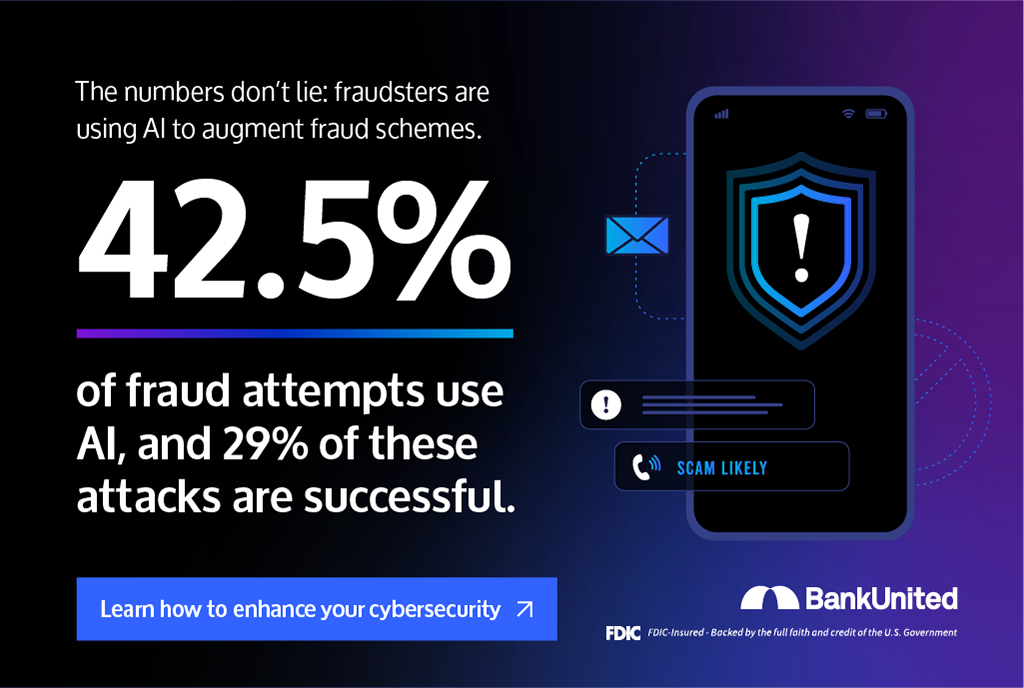
42.5% of fraud attempts use AI

The latest evolution in cyber-enabled fraud techniques is a significant cause for concern, particularly for small and medium-sized businesses (SMBs). 

Fraudsters are supercharging existing schemes using artificial intelligence (AI), making fraud harder to detect and prevent. From sophisticated social engineering campaigns to deepfakes and AI-enabled password cracking, a new generation of AI-powered fraud has officially arrived.

These new, AI-powered fraud attacks have in common the ability for attackers to compromise targets in less time. As David Stender, Executive Vice President, Chief Information Security Officer at BankUnited, explains, “AI allows attackers to collect information and narrow it down to what they need to compromise a target in microseconds, where that may have taken months of research in the past.” Now, with the ability to execute more successful attacks on more businesses, the cost of cybercrime is only expected to grow—to about $9.5 trillion by the end of 2024. 

As AI-driven fraud becomes increasingly prevalent, small businesses must take steps to avoid these attacks. Here, we provide some background and best practices, so your business can protect itself today and in the future.  

The Evolution of Fraud: Old Tactics with New Tools

The numbers don’t lie: fraudsters are using AI to augment fraud schemes. Today, 42.5% of fraud attempts use AI, and 29% of these attacks are successful. However, AI hasn’t changed the game; it’s made old strategies much more dangerous. 

In the past, fraudsters relied on manual processes to execute schemes—scouring through endless amounts of data, conducting days' worth of research, and launching attacks based on their findings. With AI, fraudsters can gather and analyze vast amounts of information in the blink of an eye to create more frequent, targeted, and profitable attacks than ever.

“Fraud is all about analysis,” says Stender, “the more data you have, the better you can analyze it, the better your fraudulent attack will be. And all that information can be used to develop several different types of attacks.”

Preventing AI-enabled cyber fraud may seem intimidating, but with the proper precautions, protecting your business is possible. The first step is educating yourself about new tactics. 

AI’s Unfair Advantage: A Closer Look at Emerging Threats

The playing field is far from the level of the ongoing battle between businesses and cybercriminals. One of the biggest reasons is the powerful capabilities AI brings to the table for those on the wrong side of the law. 

“The fraudsters do have a slight advantage,” Stender notes, “because they can take advantage of the full capability without restraints or constraints.” While businesses are just beginning to tap into the potential of AI, fraudsters are already using it to devastating effects, leveraging both predictive AI and generative AI to launch sophisticated attacks. 

Examples of AI-Powered Cyber Fraud

Here are some of the most concerning AI-powered fraud attacks cybercriminals are launching today:

  • AI-Driven Phishing Attacks: Traditionally, phishing emails were easy to spot due to typos, poor formatting, and other mistakes. Now, AI allows cybercriminals to craft nearly flawless emails that mimic someone’s writing style right down to the signature. But these attacks aren’t limited to emails—they also arrive via texts, voice messages, and videos. 

  • Deepfake Technology: Attackers can create realistic videos and audio that imitate a person’s voice, face, and gestures. These deepfakes are used to spread misinformation, perpetrate financial fraud, and ruin reputations at an unprecedented scale. 

  • AI-Powered Password Cracking: With AI tools that dredge the dark web for information, fraudsters can guess passwords with terrifying accuracy. Gone are the days of brute force attacks; now, tools like PassGAN can crack 51% of passwords in less than a minute. 

  • Automated Vulnerability Scanning: Hackers also use AI to scan for and exploit vulnerabilities in software systems at remarkable speed and scale. Small businesses, often with limited resources for frequent software updates, are particularly vulnerable. 

  • AI-Enabled Ransomware: With AI allowing attackers to encrypt critical business data in the blink of an eye, ransomware attacks have become more targeted and efficient—leaving businesses with little time to react.  

As AI continues to evolve, the gap between what cybercriminals can do and what businesses can defend against is only widening. “You’ll find that in the cybersecurity and fraud world,” Stender says, “hope is an actual strategy.” 

Defending Against AI-Powered Fraud

Small businesses may seem like easy targets for AI-driven fraud, but they have unique advantages to help them fight back. 

One of the biggest strengths lies in close-knit leadership teams. When everyone knows each other well, it’s easier to spot inconsistencies. Even if your business operates in unconventional ways, trust your instincts. If you receive an email that seems a bit off, take a moment to step back and analyze it. If something doesn’t feel right, pick up the phone and call the person directly. And remember, face-to-face conversations are always better than video calls, which can be manipulated too. 

“It’s sort of the old school way of looking at things,” Stender says, “but in the modern world, we really need to get back to those personal connections and take a few extra steps.”

This tight-knit approach works well for small and medium-sized businesses, especially those operating in close quarters. However, it’s not as effective for geographically dispersed or entirely online companies. In those cases, staying vigilant is key. Be on the lookout for urgent messages asking for money or credentials, as these are classic signs of phishing or social engineering attacks. 

Implementing Multi-Factor Authentication (MFA) is another critical step. By requiring multiple verification forms, you make it much harder for cybercriminals to gain unauthorized access to your accounts and systems. If you encounter deepfake content involving you or someone you know, report it to the hosting platform. And if you ever suspect that your business has been targeted, don’t hesitate to submit a cyber complaint to the FBI’s Internet Crime Complaint Center

Beyond the technical defenses, personal connections and procedural due diligence can be your best allies. Always verify wire transfer instructions, be cautious when using free email accounts, and regularly change your passwords. Train your employees to detect this new generation of attacks by teaching them how to authenticate the source and content of communications. Show them what to look for, like audio or video quality inconsistencies, mismatched lip-syncing, unnatural facial movements, or uncharacteristic behavior in messages. 

Encourage your team to use secure communication methods for sensitive conversations, like Signal or Proton texting. Document your processes thoroughly and ensure everyone follows them to the letter. Give your employees the tools and authority to verify message authenticity and make it clear that management supports this verification process.

Businesses considering adopting AI should also be cautious. “Any business that wants to get into the use of AI to support their business needs to be very prudent,” Stender says, “make sure that those guard rails are in place.” And if AI tools are out of reach for your business, consider working with experts who can help you stay protected. 

Finally, partnering with a trusted bank is one of the best ways to protect your business. Ensure you have the right call-back procedures in place and that the bank covers all known numbers and emails. Building a relationship with a small business manager who knows your business well can also provide extra protection. Regularly checking in with your bank to review account activity and using any fraud detection tools they offer can give you peace of mind. 

At BankUnited, we take fraud risk management seriously, understanding that protecting your business is crucial to building a long-term relationship with our customers. We commit to continuously improving our fraud prevention strategies to ensure that your company remains secure. Contact us today if you’re ready to take fraud prevention to the next level. 


topic :
  • Fraud Prevention
media :
  • Article
42.5% of fraud attempts use AI

Primary Business Checking Account

  • $100 minimum opening deposit
  • $12 monthly maintenance fee:
  • Automatically waived for the first two statement cycles (new accounts only).

    Ways to avoid monthly maintenance fee:

    • Maintain $1,500 average monthly balance in the account or
    • Maintain $4,500 minimum daily balance in related business checking or savings account1
  • First 150 transactions per month at no charge
    • Over 150: $0.40 transaction fee
  • Cash Processing Limits: Deposit/withdraw up to $10,000 in cash per month at no charge
    • $1.50 fee per $1,000 over $10,000
  •  Complimentary Business Visa Debit Card4
  • Complimentary Online & Mobile Banking5


Business Express Checking Account

  • $100 minimum opening deposit
  • $20 monthly maintenance fee:
  • Automatically waived for the first two statement cycles (new accounts only).

    Ways to avoid monthly maintenance fee:

    • Maintain $5,000 average monthly balance in the account or
    • Maintain $10,000 minimum daily balance in related business checking or savings account1
  • First 300 transactions per statement cycle at no charge
    • Over 300: $0.40 transaction fee
  • Cash Processing Limits: Deposit/withdraw up to $15,000 in cash per month at no charge
    • $1.50 fee per $1,000 over $15,000
  • Complimentary Business Visa Debit Card4
  • Complimentary Online & Mobile Banking5


Commercial Analysis Checking Account

  • $100 minimum opening deposit
  • $20 monthly maintenance fee:
  • Earns Credit available to offset fees2

  • Transaction fee applies3
    • Cash Processing Limits: Refer to applicable fee schedule
      • Complimentary Business Visa Debit Card4
      • Online & Mobile Banking: Fees apply to Online Treasury Management Access6


      1. Related account must be in the same name as your Primary Business or Business Express Checking Account.
      2. The monthly maintenance fee may be offset by the earnings credit calculations applied on an analyzed statement at end of month. The earnings credit shall be equal to (i) the average monthly collected balance multiplied by (ii) the then applicable earnings credit rate divided by the actual number of days in the applicable year multiplied by (iii) the actual number of days in the applicable cycle. The earnings credit will be used to offset maintenance fees, transaction fees and any other service charges that may be assessed to the account. If the earnings credit rate exceeds the total monthly fees, such excess will not be carried over or applied to fees incurred in subsequent months. If the earnings credit is less than the total monthly fees, the account may be charged for the amount of the difference. If the earnings credit is negative, the account may be charged the full amount of the fees.
      3. Transaction fees are attained for the following and will be priced accordingly at the time you elect the service.
        • For each check and/or debit paid per statement cycle
        • For each ACH Credit per statement cycle
        • Per deposit credited per statement cycle
        • Per item deposited per statement cycle
      4. You'll get a BankUnited Visa® Business Debit Card with no-fee transactions at BankUnited ATMs. A $2.50 fee will be charged for each transaction performed at a non-proprietary ATM that is not within the Allpoint Network. Fees charged by the ATM owner/operator may also apply.
      5. Requires enrollment.
      6. Pricing provided by our Treasury Management team. Pricing may be different at the time you elect the service. Please contact a Treasury Management Officer for additional information.


      Rates and annual percentage yields (APYs) are effective as of the date indicated and are subject to change without notice unless otherwise stated. Fees may reduce earnings on the account. Products, services, fees, terms and conditions are subject to change. Certain restrictions and limitations may apply. Contact BankUnited for complete account details.

      Please review the see our Deposit Account Agreement, Business Schedule of Fees and Funds Availability Disclosure for complete details.
