
Skip To Main Content

FDIC-Insured - Backed by the full faith and credit of the U.S. Government

Business Owners discussing financials

Checking Accounts Built For Business Growth

Choose a small business checking account designed to support your day to day operations and long term goals. Whether you need a simple business checking account or more advanced capabilities, BankUnited offers flexible solutions for your business.
Compare All Accounts

Compare Small Business Checking Accounts

PRIMARY BUSINESS CHECKING

$100

minimum opening deposit

  • $12 monthly maintenance fee - Avoid maintenance fee by maintaining average monthly balance of $1500 or more
  • Up to 150 free transactions (deposits, deposited items, checks & debits) per statement cycle
  • Business VISA® Debit Card
  • Bank on the go with online & mobile banking


BUSINESS EXPRESS CHECKING

$100

minimum opening deposit

  • $20 monthly maintenance fee - Avoid monthly maintenance fee by maintaining average monthly balance of $5000 or more
  • Up to 300 free transactions (deposits, deposited items, checks & debits) per statement cycle
  • Business VISA® Debit Card
  • Bank on the go with online & mobile banking


COMMERCIAL ANALYSIS CHECKING

$100

minimum opening deposit

  • $20 monthly maintenance fee
  • Earnings credit available to help offset monthly maintenance fees and other service charges
  • Detailed analysis statements to help keep track of your business banking (upon request)
  • Business VISA® Debit Card
  • Online treasury management services to manage your company's payments, collections, reporting and account balancing

Business Checking Account Benefits

Regardless of your choice, each of our small business bank accounts is built to deliver value, convenience, and control for your business finances.

white bill pay icon

Online Bill Pay

white debit card

Debit Card

estatement white icon

eStatements

white online banking icon

Online and Mobile Banking

Small Business Checking Accounts FAQs


Get answers to common questions about choosing and managing the best business checking account for your company.

The best business checking account depends on your transaction volume, balance, and banking needs. BankUnited offers multiple small business checking accounts to match different business sizes and activity levels.  

You can open a business checking account by contacting BankUnited or visiting a branch. You will typically need business formation documents, identification, and an opening deposit.  

Fees may include monthly maintenance charges, transaction fees, and cash processing fees. Many fees can be avoided by maintaining required balances.  

Yes, BankUnited provides online and mobile banking tools so you can manage your small business bank account anytime, including payments, transfers, and account monitoring.  

Interested in a Business Checking Account?


Whether you’re starting a new business or looking for a better banking experience, BankUnited is here to help you find the business checking account that fits your needs. Complete the form below and a Business Banking specialist will contact you shortly.

Featured Insights

BankUnited supports small businesses with financial tools, insights, and personalized service to help you succeed. From managing cash flow to planning for growth, we are here to help every step of the way.

Strategies to Protect Your Business from Fraudsters
Sep 12, 2024, 16:07 PM
Title : Strategies to Protect Your Business from Fraudsters
Bank united author : BankUnited
Featured : No
Display order :
Check out insights on protecting your small business from fraud attacks.
graphic of laptop with credit card and icon of a person with text

From the rise in business email compromise schemes to the ever-present threat of check fraud, small businesses must navigate an increasingly complex threat landscape. No matter the size of your business, it’s possible to become a victim of fraud. Criminals constantly evolve tactics, targeting technology and human behavior for potential weaknesses and security lapses. 

For many reasons, often related to understandable budget constraints, small businesses can lack robust security measures and dedicated IT and fraud teams. Nonetheless, small business owners must stay vigilant, educate their employees, and adopt security practices that make them less likely to become victims.

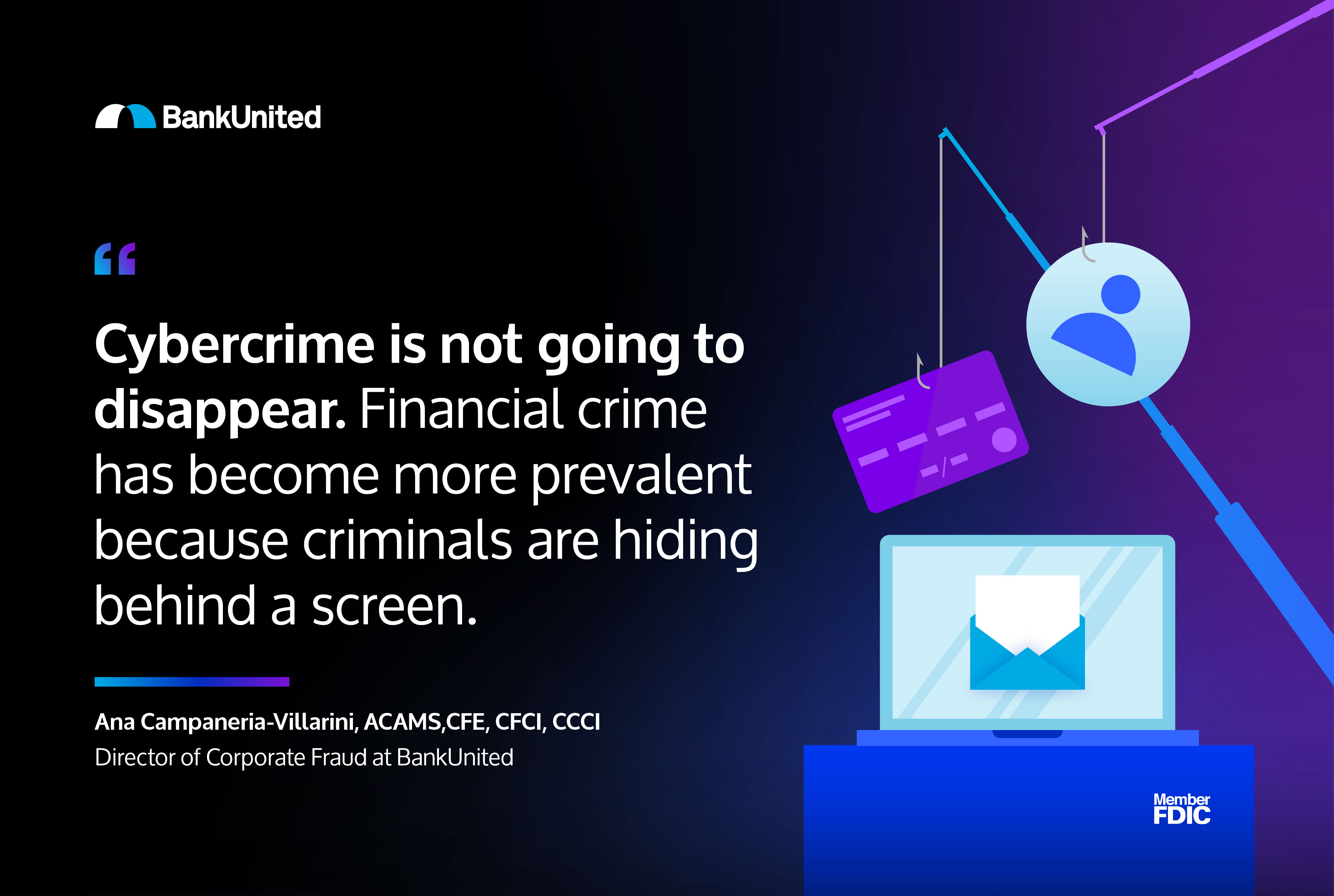
“Cybercrime is not going to disappear. Financial crime has become more prevalent because criminals are hiding behind a screen,” says Ana Campaneria-Villarini, Senior Vice President and Director of Corporate Fraud at BankUnited.

So how can small businesses with limited budgets combat fraud, especially when criminals are increasing their use of artificial intelligence to make their fraud attempts harder to detect and prevent?

Recognizing Business Email Compromise

From Campaneria-Villarini’s perspective, business email compromise schemes are one of the most common and financially damaging forms of fraud targeting businesses of all sizes. 

According to the FBI, business email compromise (BEC) is a scam in which “criminals send an email message that appears to come from a known source making a legitimate request.” This can take the form of a vendor sending an invoice with an updated mailing address, a title company messaging a recent homebuyer with false instructions for a wire payment, or your own company’s CEO reaching out with an urgent request to purchase dozens of gift cards. 

“In the past, we used to frequently see more email compromises, where the email addresses consisted of a missing digit on the email address, or an extra L or an extra I,” says Campaneria-Villarini. “In addition to that, the verbiage in the body of the email contained grammar and spelling errors, which made it a little bit easier to detect that something was not right.” 

However, criminals today are much more sophisticated in how they compromise and use email to commit fraud.

“Now the entire email account is being compromised and the fraudster then studies the behavior of that victim, to make the email communication seem more realistic. So, the email address is the same, and the verbiage and the communication style are very similar to the actual party,” adds Campaneria-Villarini. 

With this insight, the emails criminals send to deceive someone into sending a payment are much more convincing. BEC is most effective from Campaneria-Villarini’s perspective when the email is well-timed. “If the victim is expecting an invoice or payment instructions, let's say for a real estate deal, they're simply going to proceed because it's not an unsolicited email.” Campaneria-Villarini notes that most, if not all, BECs could be prevented with a simple call back to the email sender's number on file for verification.

Check Fraud: A Perennial Favorite with Fraudsters

While BEC schemes plague businesses, an even older form of financial fraud continues to generate significant losses. In fact, Campaneria-Villarini notes that financial institutions are seeing substantial increases in check fraud losses. 

“We have a mail theft epidemic resulting in a check fraud epidemic,” says Campaneria-Villarini. “Checks intercepted and stolen in the mail are being posted on the dark web within 24 hours, resulting in counterfeits and stolen checks being negotiated quickly by unauthorized parties.” 

Cybercriminals are also using stolen check information and personal identifiable information (PII) to commit account fraud. “Fraudsters are opening accounts online with the intent to commit fraud. It is much easier behind a screen to open an account and deposit stolen checks via mobile deposit,” notes Campaneria-Villarini.

Fraud Liability: A Complex Topic

While combatting fraud is the primary goal, Campaneria-Villarini emphasizes the need for small businesses to understand the nuances of fraud liability. 

“There is a misconception that financial institutions must reimburse account holders for all fraud, even when the account holder originates the payment,” says Campaneria-Villarini. Yet, different rules govern each payment type. “For example, with checks, financial institutions are expected to reimburse the account holder when their signature on the check has been compromised (i.e. counterfeit, forged maker) if the fraud incident is reported timely, according to the financial institution's Depositors Agreement,” adds Campaneria-Villarini.

These misconceptions can create friction when small business owners expect the bank to cover losses from fraud. While Campaneria-Villarini stresses that financial institution's fraud teams will work hard to recover funds, the liability ultimately may rest with the customer in many cases.

Therefore, she encourages small businesses to educate themselves on liability for fraudulent transactions, as this manages expectations and helps to maintain a productive and fully informed relationship between a business and its financial institution.

Prioritizing Fraud Prevention

Given the sophistication of the threat facing small businesses, it is essential to adopt a multifaceted approach to combating fraud. 

The security of email accounts is paramount to preventing BEC schemes. Complex passwords and multi-factor authentication are critical to preventing unauthorized access. Blocking employee access to personal email and social media on work devices can also help, as they can serve as entry points for phishing scams.

Campaneria-Villarini also recommends that small businesses partner with reputable web hosting and information security companies that can provide advanced endpoint security, including anti-virus and malware protection. She also recommends cybersecurity insurance and a willingness to continually evaluate its processes and procedures for potential weaknesses.

When it comes to ACH and check fraud, Campaneria-Villarini strongly encourages business owners to enroll in the fraud prevention products most banks offer to prevent fraud. For example, ACH alerts send emails to the account holder when there is an ACH debit from an unapproved party, while Payee Positive Pay can also help detect and prevent check fraud by generating an alert when a check is presented for payment that does not match the account holder's issued checks and Reverse Positive Pay generates an email for all checks being presented for payment for the account holder to approve or reject the item. Additionally, Campaneria-Villarini recommends that checks be dropped off directly inside the post office or via USPS Scheduled Pickup, avoiding street USPS collection boxes, apartment and building cluster box units, residential mailboxes and any other public mail drop off. 

From sophisticated email compromise to persistent check fraud, your business faces an ever-evolving landscape of fraud threats. To combat the threat, you must stay vigilant, leverage your bank’s fraud tools, and implement strong cybersecurity measures. By doing so, you can significantly reduce the risk of becoming a victim of fraud.

BankUnited’s suite of treasury solutions offer ACH services, as well as other fraud prevention tools to keep your hard earned finances safe. Learn more here. 

topic :
  • Fraud Prevention
media :
  • Article
graphic of laptop with credit card and icon of a person with text

Primary Business Checking Account

  • $100 minimum opening deposit
  • $12 monthly maintenance fee:
  • Automatically waived for the first two statement cycles (new accounts only).

    Ways to avoid monthly maintenance fee:

    • Maintain $1,500 average monthly balance in the account or
    • Maintain $4,500 minimum daily balance in related business checking or savings account1
  • First 150 transactions per month at no charge
    • Over 150: $0.40 transaction fee
  • Cash Processing Limits: Deposit/withdraw up to $10,000 in cash per month at no charge
    • $1.50 fee per $1,000 over $10,000
  •  Complimentary Business Visa Debit Card4
  • Complimentary Online & Mobile Banking5


Business Express Checking Account

  • $100 minimum opening deposit
  • $20 monthly maintenance fee:
  • Automatically waived for the first two statement cycles (new accounts only).

    Ways to avoid monthly maintenance fee:

    • Maintain $5,000 average monthly balance in the account or
    • Maintain $10,000 minimum daily balance in related business checking or savings account1
  • First 300 transactions per statement cycle at no charge
    • Over 300: $0.40 transaction fee
  • Cash Processing Limits: Deposit/withdraw up to $15,000 in cash per month at no charge
    • $1.50 fee per $1,000 over $15,000
  • Complimentary Business Visa Debit Card4
  • Complimentary Online & Mobile Banking5


Commercial Analysis Checking Account

  • $100 minimum opening deposit
  • $20 monthly maintenance fee:
  • Earns Credit available to offset fees2

  • Transaction fee applies3
    • Cash Processing Limits: Refer to applicable fee schedule
      • Complimentary Business Visa Debit Card4
      • Online & Mobile Banking: Fees apply to Online Treasury Management Access6


      1. Related account must be in the same name as your Primary Business or Business Express Checking Account.
      2. The monthly maintenance fee may be offset by the earnings credit calculations applied on an analyzed statement at end of month. The earnings credit shall be equal to (i) the average monthly collected balance multiplied by (ii) the then applicable earnings credit rate divided by the actual number of days in the applicable year multiplied by (iii) the actual number of days in the applicable cycle. The earnings credit will be used to offset maintenance fees, transaction fees and any other service charges that may be assessed to the account. If the earnings credit rate exceeds the total monthly fees, such excess will not be carried over or applied to fees incurred in subsequent months. If the earnings credit is less than the total monthly fees, the account may be charged for the amount of the difference. If the earnings credit is negative, the account may be charged the full amount of the fees.
      3. Transaction fees are attained for the following and will be priced accordingly at the time you elect the service.
        • For each check and/or debit paid per statement cycle
        • For each ACH Credit per statement cycle
        • Per deposit credited per statement cycle
        • Per item deposited per statement cycle
      4. You'll get a BankUnited Visa® Business Debit Card with no-fee transactions at BankUnited ATMs. A $2.50 fee will be charged for each transaction performed at a non-proprietary ATM that is not within the Allpoint Network. Fees charged by the ATM owner/operator may also apply.
      5. Requires enrollment.
      6. Pricing provided by our Treasury Management team. Pricing may be different at the time you elect the service. Please contact a Treasury Management Officer for additional information.


      Rates and annual percentage yields (APYs) are effective as of the date indicated and are subject to change without notice unless otherwise stated. Fees may reduce earnings on the account. Products, services, fees, terms and conditions are subject to change. Certain restrictions and limitations may apply. Contact BankUnited for complete account details.

      Please review the see our Deposit Account Agreement, Business Schedule of Fees and Funds Availability Disclosure for complete details.
