Skip To Main Content

FDIC-Insured - Backed by the full faith and credit of the U.S. Government

Male business owner on computer

Unlock the Right SBA Loan

Whether you're just starting a small business or expanding to take advantage of new opportunities, a loan through the U.S. Small Business Administration (SBA) may be right for you.

SBA Loans To Grow Your Business

As an SBA Preferred Lender, BankUnited can provide flexible financing with lower down payments and an easier path to approval so you can enhance cash flow and focus on growth.

experience icon

Experienced SBA Guidance

real estate loans

Acquire a Business or Franchise

bars of gold with flag icon

Finance Equipment, Growth, & More

treasury icon

Refinance an Existing Loan

Document with Checkmark

Flexible Terms Tailored to Your Needs

Trusted Logo

May Offer More Flexible Qualification Requirements Than Certain Conventional Loan Programs

Business Owners looking at inventory

SBA 7(a) Loan

The SBA 7(a) loan is a versatile small business loan designed to support a wide range of financing needs, from working capital to real estate. 


Why an SBA 7(a) loan?
  • Long repayment terms – reducing monthly payments
  • Down payments as low as 10%
  • Frees up cash for expansion
  • Financing available for various industries, including manufacturing, hospitality, and more

SBA 504 Loan

A smart option for major fixed assets, SBA 504 loans provide long-term financing for real estate and equipment with less equity required than a conventional loan.


Why an SBA 504 loan?
  • Low down payment of only 10%
  • Long repayment terms – reducing monthly payments
  • Frees up cash flow for growth
  • Flexible rate options, including fixed rates
  • Fees and soft costs may be financed
man on computer

Small Business Banking Resources

BankUnited supports entrepreneurs with tailored small business banking solutions designed to help manage cash flow and plan for growth. Our team delivers guidance and tools that align with your long-term goals.

From daily banking needs to strategic financing solutions like SBA loans, we equip your business with the resources to operate efficiently and expand with confidence.
irrevocable trust icon

Flexible financing options

joint ownership icon

Relationship focused support

Spending Insight

Scalable banking tools

SBA Loans FAQs


Get answers to common questions about small business administration loans and how BankUnited can help you apply for an SBA loan.

SBA loans are small business loans partially guaranteed by the U.S. Small Business Administration, designed to make financing more accessible with flexible terms.

You can apply for an SBA loan by working with an approved lender like BankUnited, who will guide you through the SBA loan application and documentation process step-by-step.

An SBA 7(a) loan can be used for working capital, business acquisition, equipment purchases, refinancing, and commercial real estate.

SBA lending solutions offer lower down payments, longer repayment terms, and more flexible qualification requirements than many conventional small business loans.

For many businesses, SBA loans are considered among the best small business loans due to their favorable terms and broad range of uses.

Contact Us to Apply for an SBA Loan  


Connect with our team to explore the best small business loans for your needs. We are here to guide you through every step of the SBA loan application process.

Featured Insights

Get insights on starting and growing your business, managing cash flow, protecting your assets, stories from real clients, and much more.

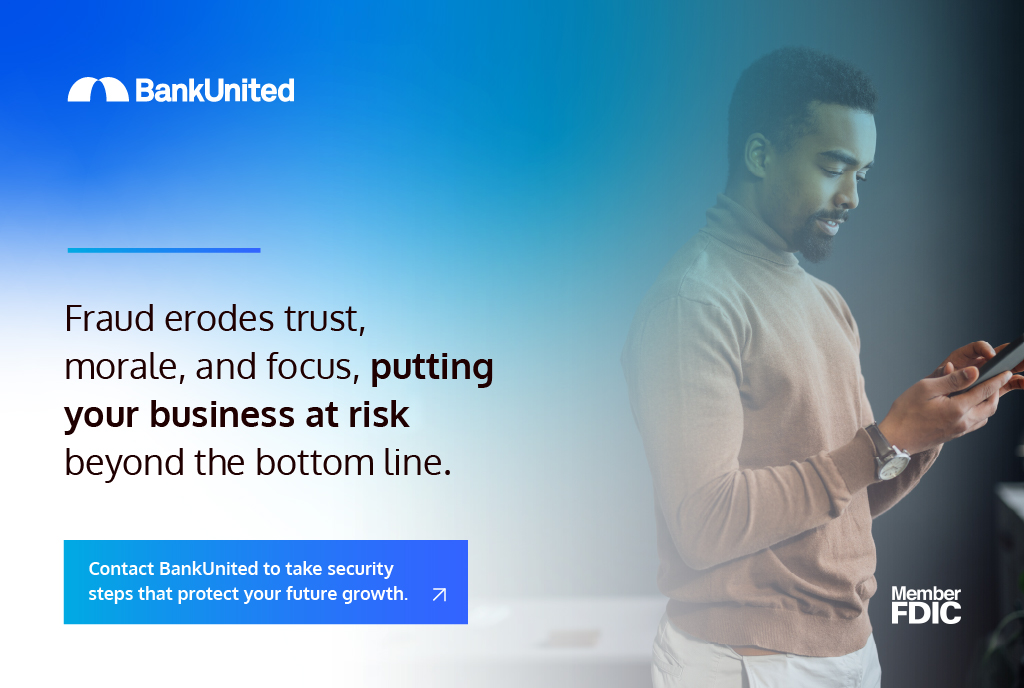
The Hidden Costs of Fraud for Small Businesses
Jan 5, 2026, 09:00 AM
Title : The Hidden Costs of Fraud for Small Businesses
Bank united author : BankUnited
Featured : No
Display order : 1
Learn the hidden costs of fraud for small business and how to prevent them.
person on phone

Fraud isn’t just about the money lost; it can damage reputation, relationships, and growth potential. To minimize losses, small business owners must understand the real costs of fraud and take practical, low-cost steps to reduce risk. When every dollar and relationship matters, understanding these hidden costs and acting early is critical. And, as we’ll learn, there’s also a role for a trusted banking partner that can provide both security-related technology and expert guidance.

The True Cost of Fraud

In a recent BankUnited survey of 200 small- and medium-sized businesses (SMBs), 21% reported that managing business risk, including fraud, was a top priority for the next 12 months. Whether a business realizes it or not, fraud is a pressing problem for most SMBs. While fraud is not a foregone conclusion, every company that employs workers and sells to customers runs the risk of it. Chargebacks, insurance hikes, and investigation costs are just some of the financial implications of fraud.

While monetary losses are often the easiest to quantify, the impact of fraud extends far beyond the bottom line. When a business experiences fraud, its reputation suffers. In some cases, customers may hesitate to continue doing business with a company that is still recovering from the aftermath of fraud. At the same time, suppliers can lose confidence that the business will survive and pay its debts. Investors may become nervous and seek ways to reduce or terminate their relationship with a struggling company.

When fraud occurs, leadership must shift its focus from running the business to restoring normal operations and fortifying protections. In some cases, that effort can take months or even years to accomplish. When distracted, critical business decisions go unaddressed, further amplifying the impact of the fraud and extending it far beyond the financial losses. All the while, trust erodes, morale drops, and fatigue sets in.

Simple, Affordable Prevention Moves

Fraud happens for a multitude of reasons. Often, there’s a lack of management oversight because excessive trust is placed on customers, suppliers, and employees to always do the right thing when no one is watching. However, there’s good news: stopping most fraud doesn’t require expensive software; it simply requires structure, discipline, and awareness. For example, separating financial duties, requiring dual approval for certain transactions, and reviewing accounts for signs of wrongdoing are critical to detecting anomalies and mitigating fraud losses.

Multi-factor authentication can also reduce fraud risks as it requires the submission of a username, a password, and one or more additional factors to complete a login. Therefore, if an employee inadvertently shares their credentials, it will be more difficult for a would-be fraudster to use them. Business email compromises can be mitigated by enforcing frequent password changes as a best practice and blocking the reuse of login credentials across multiple systems.

Training and testing employees on their knowledge of fraud is also a worthwhile investment. Such training will increase their ability to detect fraud and enhance the “perception of detection,” meaning they will be more aware of the company’s commitment to fraud prevention and less likely to succumb to temptation and engage in financial crime themselves. Encouraging whistleblowing via anonymous channels is also an effective tactic. Whether you encourage employees to call a hotline, submit concerns anonymously via an online form, or send written documents, providing employees with the means to raise concerns is crucial to combating fraud.

Your Bank as a Security Partner

While your bank is instrumental in processing transactions, it can also serve as a valuable ally in providing security. To ensure individuals and businesses can conduct transactions safely and securely, financial institutions invest heavily in fraud detection and prevention technologies. These include built-in detection tools that operate in the background during transaction processing, account alerts, document analysis solutions, and sophisticated data analytics that can proactively identify anomalies that would otherwise go unaddressed.

With numerous high-performing tools available, asking your institution to review its current fraud-prevention features will undoubtedly reveal tools like check fraud detection that can help reduce the likelihood of your business experiencing losses.

Changing the Culture  

When it comes to fraud prevention, there’s no finish line for businesses to cross. Instead, it requires an unrelenting commitment to combating the threat. To be effective, fraud prevention must become part of your organization’s culture. Even the best tools fail if people stop paying attention.

Conducting quarterly reviews of your internal controls, rotating responsibilities to prevent employees from becoming too comfortable in their roles and rewarding vigilance when employees uncover fraud schemes are essential. So, while technology can play an important role, when mixed with the right culture, your business can improve the effectiveness of its countermeasures.

Conclusion

Fraud’s real cost extends far beyond dollars and cents to include the loss of trust, morale, and focus. Simply put, if one fraud incident can wipe out months of profit, the damage doesn’t stop there. It can weaken customer trust, stall growth, and drain morale. Taking small actions today can help prevent devastating losses tomorrow. While losing money to fraud is a possibility, your business need not suffer catastrophic losses. Audit your defenses, trust your financial institution, and turn vigilance into your business advantage.   

If your business needs enhanced protection against fraud, contact BankUnited today to discover how their team can help you mitigate your risks.

topic :
  • Fraud Prevention
  • Small Business
media :
  • Article
person on phone

SBA 7(a) Loan

Use of Proceeds:

  • Real estate – purchase, construction, renovation or refinance of commercial real estate – majority of space must be owner-occupied; loans up to $5 million
  • Business acquisition – business, franchise or professional practice; loans up to $5 million
  • Machinery & equipment – purchase or refinance; loans up to $5 million
  • Start-up – franchised businesses; loans up to $5 million

Terms:

  • Real estate – up to 90% financing, up to 25 years, prepayment penalty for initial 3 years (none after the end of year 3)
  • Business acquisition – up to 80% financing, up to 10 years, no prepayment penalty
  • Refinance – up to 25 years, prepayment penalty applicable for initial 3 years on terms greater than 15 years
  • Rates are based on a spread over the Prime Lending Rate (rates vary depending on the specific strengths of the transaction)
  • SBA Guarantee Fee is paid directly to the U.S. Small Business Administration; amount varies based on loan/guarantee amount; other customary fees also apply
  • All SBA 7a loans are fully amortized and are assumable

SBA 504 Loan

Use of Proceeds:

  • Purchase, refinance, construction, or renovation of owner-occupied commercial real estate
  • Purchase and installation of long-life machinery and equipment 
  • 50% financing – first mortgage from BankUnited
  • 40% financing – SBA 504 second mortgage (provided through a local Certified Development Corporation)
  • 10% minimum down payment by the borrower (15% in the case of special use properties)

Terms:
Fixed and variable rates available.

First mortgage:

  • Up to 25 years, fully amortized
  • Prepayment penalty applies and is set based on various factors

Second mortgage:

  • 20 year, fully amortized
  • Fixed rate is determined at SBA-guaranteed 504 debenture sale


*Minimum borrower equity contribution varies based on loan structure, collateral, use of proceeds, borrower experience, and SBA program requirements


Interest rates, fees, and program terms vary based on loan structure, borrower qualifications, collateral, and SBA requirements.


All loans are subject to credit and property approval. Program not available in all states. Program terms and conditions are subject to change without notice. Other restrictions, limitations and fees may apply. All loans are offered through BankUnited, N.A. This is not a commitment to lend.